CareFlow AI Clinical Assistant
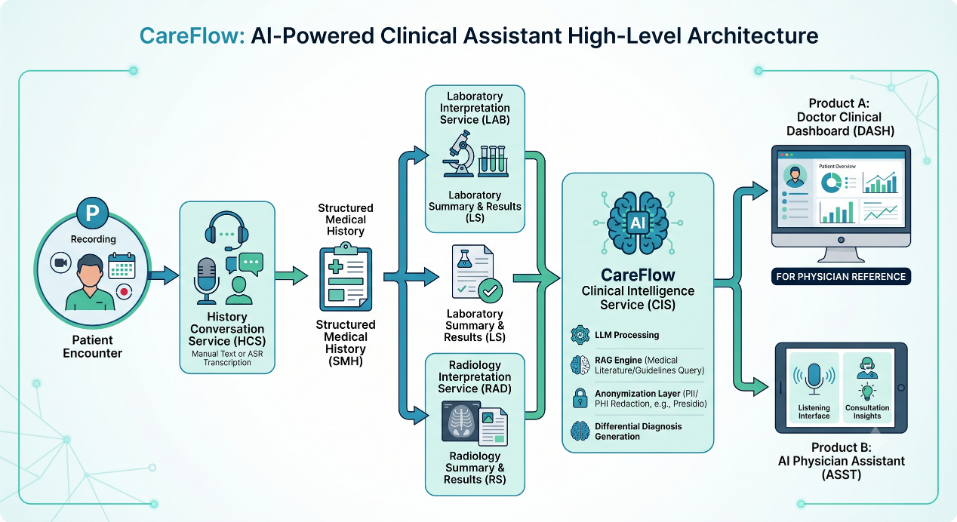
CareFlow is an enterprise-grade, 10-microservice AI clinical copilot platform engineered to reduce physician administrative documentation time by up to 40%. The platform seamlessly orchestrates real-time Arabic speech-to-text intake (Cohere/Whisper), medical vision models (MedGemma 1.5 4B IT and MedSAM 2.0), layout-aware Lab OCR with 98% recall PII anonymization, and a 1024-dim BGE-M3 vector RAG engine in Qdrant to deliver evidence-grounded differential diagnoses and automated SOAP notes.
Problem Statement
Physicians spend up to 40% of their workday typing consultation notes, transcribing patient history, and manually inspecting legacy lab PDFs and radiology scans. In overburdened healthcare systems, this administrative workload causes physician burnout and contributes to a 20% patient misdirection rate at initial clinic entry. Existing clinical software lacks real-time Arabic speech understanding, automated multi-modal diagnostic assistance, and secure edge PII redaction.
Solution
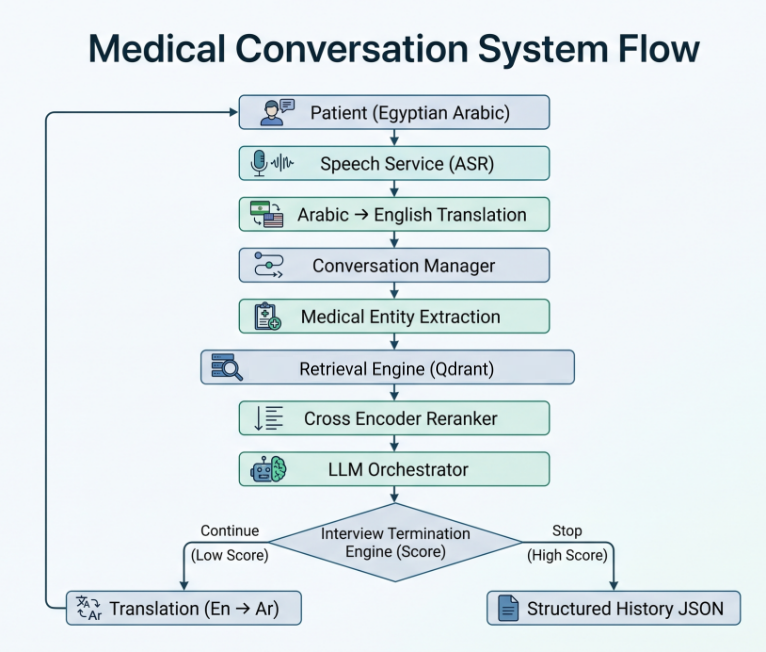
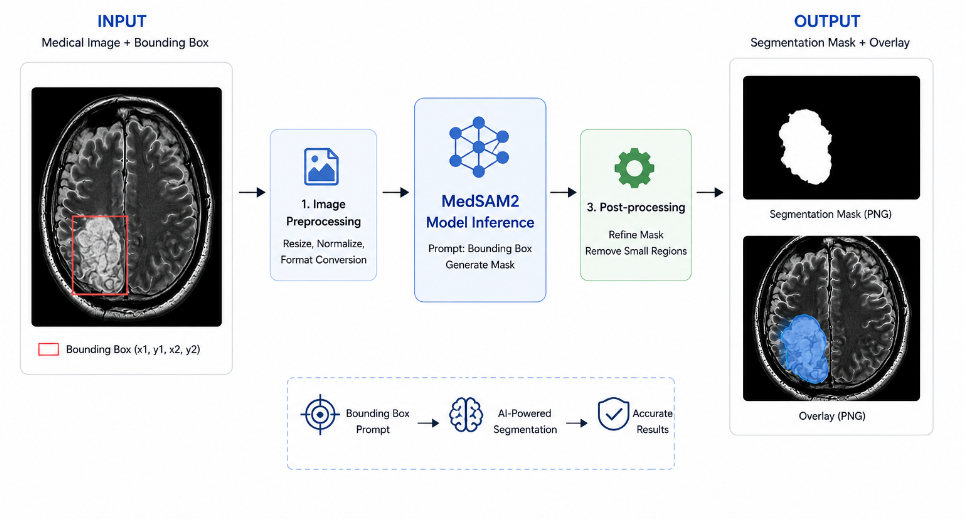
Engineered CareFlow, a 10-microservice clinical copilot platform that automates the patient journey from symptom intake to diagnostic support. Built an Arabic voice ingestion pipeline using fine-tuned ASR models (Cohere/Whisper) connected to a LangGraph clinical interview state machine. Integrated vision-language models (MedGemma 1.5 4B IT) and promptable 2D ROI segmentation (MedSAM 2.0) for radiology interpretation. Implemented a layout-aware OCR engine with 98% recall PII redaction for lab reports, and anchored all diagnostic suggestions in a 1024-dim BGE-M3 vector RAG pipeline querying PubMed and WHO guidelines in Qdrant.
Architecture
CareFlow operates as a decoupled multi-microservice architecture managed by an API Gateway (workflow-orchestrator). Product A handles real-time voice history taking using FastAPI WebSocket streams, LangGraph interview graphs, and PostgreSQL state snapshots. Product B powers clinical decision support through asynchronous services: radiology analysis (MedGemma 1.5), lesion segmentation (MedSAM 2.0), lab report extraction (PaddleOCR/MinerU), PII masking (Qwen2.5-7B on Modal GPU), and dense vector RAG (Qdrant + BGE-M3). The physician interacts with a real-time Next.js 14 Doctor Portal.
Key Features
- ▸Real-time Arabic speech-to-text intake (ar-EG) for automated voice history taking
- ▸LangGraph clinical interview state machine with dynamic symptom extraction
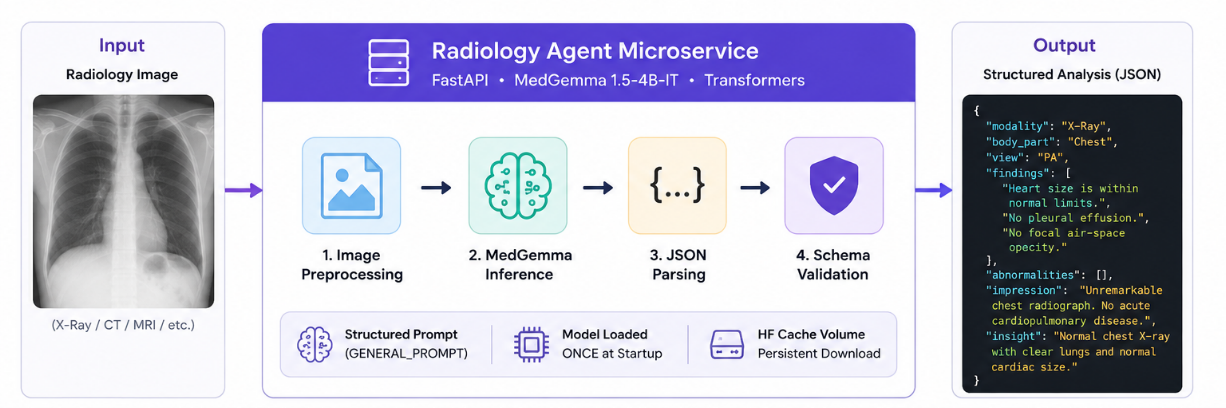
- ▸Vision-Language radiology analysis powered by google/medgemma-1.5-4b-it
- ▸Interactive 2D medical image ROI segmentation with MedSAM 2.0 (SAM 2.1 Hiera Small)
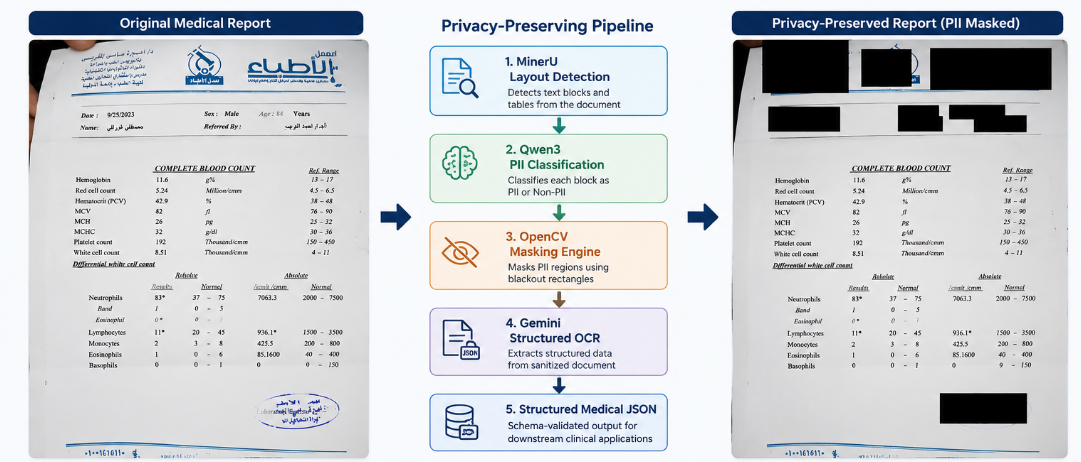
- ▸Layout-aware Lab OCR with 96% precision / 98% recall automated PII redaction
- ▸1024-dimensional dense BGE-M3 vector search over medical references in Qdrant
- ▸Automated SOAP note generation and physician-in-the-loop diagnostic approval
- ▸Serverless GPU deployment on Modal with persistent Hugging Face weight caching
Challenges
- ⚡Low-Latency Streaming Speech Ingestion. Engineered a WebSocket audio streaming pipeline with LangGraph state machine persistence to handle real-time Egyptian Arabic voice chunks without audio frame loss or latency spikes.
- ⚡Multi-Modal Clinical Data Harmonization. Integrated disparate vision model findings (MedGemma 1.5), 2D lesion masks (MedSAM 2.0), lab OCR tables, and PubMed guidelines into a unified, non-conflicting SOAP note payload.
- ⚡Handling heterogeneous lab report layouts without breaking tables. Implemented layout-aware document chunking (MinerU) coupled with regex scrubbing to preserve reference range relationships.
- ⚡Handling asynchronous out-of-order document uploads in the Doctor Portal. Refactored single-string Encounter status states into step-completion bitmasks to prevent UI lockout when lab/radiology reports arrive post-interview.
Results & Metrics
40% reduction in physician documentation time per patient encounter
88% medical vision diagnostic accuracy achieved with MedGemma 1.5 4B IT
92% zero-shot JSON schema parsing rate for radiological report synthesis
0.88 - 0.93 Dice Coefficient & 3.2mm HD95 boundary precision in MedSAM 2.0 segmentation
98% PII redaction recall score guaranteeing HIPAA-compliant data handling
1.2s GPU inference latency for radiology image assessment (bfloat16 on CUDA)
20% improvement in RAG diagnostic retrieval relevance via BGE-M3 dense embeddings
100% platform microservice integration completion rate across 10 microservices
Lessons Learned
- 💡Layout-aware parsing (e.g. MinerU) is essential for lab reports because standard text chunking fragments lab value reference tables.
- 💡Serverless GPU weight caching via persistent Docker volumes (hf_cache) or Modal Volumes reduces cold-start latency from 45s down to 1.2s.
- 💡Decoupling voice intake from lab and radiology analysis into asynchronous microservices enables doctors to process multi-modal patient files seamlessly as they arrive throughout the shift.
Case Study Overview
Case Study: Engineering CareFlow - The Intelligent Clinical Copilot
CareFlow is a state-of-the-art healthcare AI ecosystem designed to streamline the complete clinical journey. Built across 10 decoupled microservices, CareFlow bridges patient intake, voice history collection, multi-modal lab/radiology analysis, and evidence-based decision support into a unified physician dashboard.
System Architecture & Service Mesh
The CareFlow platform is architected around two core operational products managed by an API Gateway (workflow-orchestrator):
                    ┌───────────────────────────────────────────┐
                    │         Next.js 14 Doctor Portal          │
                    └─────────────────────┬─────────────────────┘
                                          │ (REST / WebSocket)
                                          ▼
                    ┌───────────────────────────────────────────┐
                    │   Workflow Orchestrator (API Gateway)     │
                    └─────────────────────┬─────────────────────┘
                                          │
                 ┌────────────────────────┴────────────────────────┐
                 ▼                                                 ▼
  ┌──────────────────────────────┐                  ┌──────────────────────────────┐
  │   PRODUCT A: VOICE INTAKE    │                  │   PRODUCT B: AI ASSISTANT    │
  ├──────────────────────────────┤                  ├──────────────────────────────┤
  │ • history-service            │                  │ • decision-support-service   │
  │   (LangGraph State Machine)  │                  │   (SOAP & Differential Dx)   │
  │ • asr (Cohere / Whisper)     │                  │ • radiology-service          │
  │ • PostgreSQL (Encounters)    │                  │   (MedGemma 1.5 4B VLM)      │
  └──────────────────────────────┘                  │ • medsam-2-segmentation      │
                                                    │   (SAM 2.1 Hiera Small)      │
                                                    │ • lab-service (PaddleOCR)    │
                                                    │ • masking-ocr (Qwen2.5 7B)   │
                                                    │ • data-ingestion (BGE-M3)    │
                                                    │ • Qdrant Vector DB           │
                                                    └──────────────────────────────┘
Performance Benchmarks & Key Numbers
| Component / Subsystem | Benchmark / Metric | Achieved Result | Impact / Significance |
|---|---|---|---|
| Clinic Entry Triage | Patient Misdirection Rate | Reduced from 20% | Directs patients to correct specialty (Internal, Neuro, Oncology) |
| Radiology VLM | MedGemma 1.5 4B Accuracy | 88.0% Accuracy | High-fidelity zero-shot report generation |
| Radiology VLM | Zero-Shot JSON Parse Rate | 92.0% Rate | Guarantees structured schema output for findings/impressions |
| Radiology VLM | GPU Inference Latency | 1.2 Seconds | Evaluated on CUDA (bfloat16) vs 14.0s CPU fallback |
| ROI Segmentation | MedSAM 2.0 Dice Score | 0.88 - 0.93 | Precise 2D lesion boundary contour extraction |
| PII Redaction | Masking Precision & Recall | 96% Prec. / 98% Rec. | Scrubs names, IDs, and dates while preserving lab tables |
| Vector RAG | Dense Embedding Size | 1024-dim BGE-M3 | Dense semantic vector embeddings for high-precision clinical retrieval |
| Voice Processing | Arabic ASR Response | ~4.5 Seconds | Serverless GPU transcription on Modal cloud |
Core Technical Breakthroughs
1. Stateful LangGraph Medical Interview Agent
Engineered an interactive voice interview graph that dynamically adjusts question sequences based on real-time symptom extraction, guiding patient intake while persisting turn-by-turn state snapshots to PostgreSQL.
2. Multi-Modal Vision & ROI Segmentation Pipeline
Combined MedGemma 1.5 4B IT for zero-shot radiological report generation with MedSAM 2.0 (SAM 2.1 Hiera Small) for interactive 2D lesion region-of-interest boundary contouring.
3. Layout-Preserving Lab OCR & PII Redaction
Deployed MinerU coupled with Qwen2.5-7B-Instruct on Modal serverless GPUs to anonymize patient PII with 98% recall while maintaining exact 2D table coordinates for downstream clinical parsing.
Technologies
Gallery
Links
Related Projects
EnergiQ AI EV Assistant
A voice-enabled AI agent integrated within the EnergiQ EV platform, enabling database function calling, a RAG system, and low-latency audio streaming.